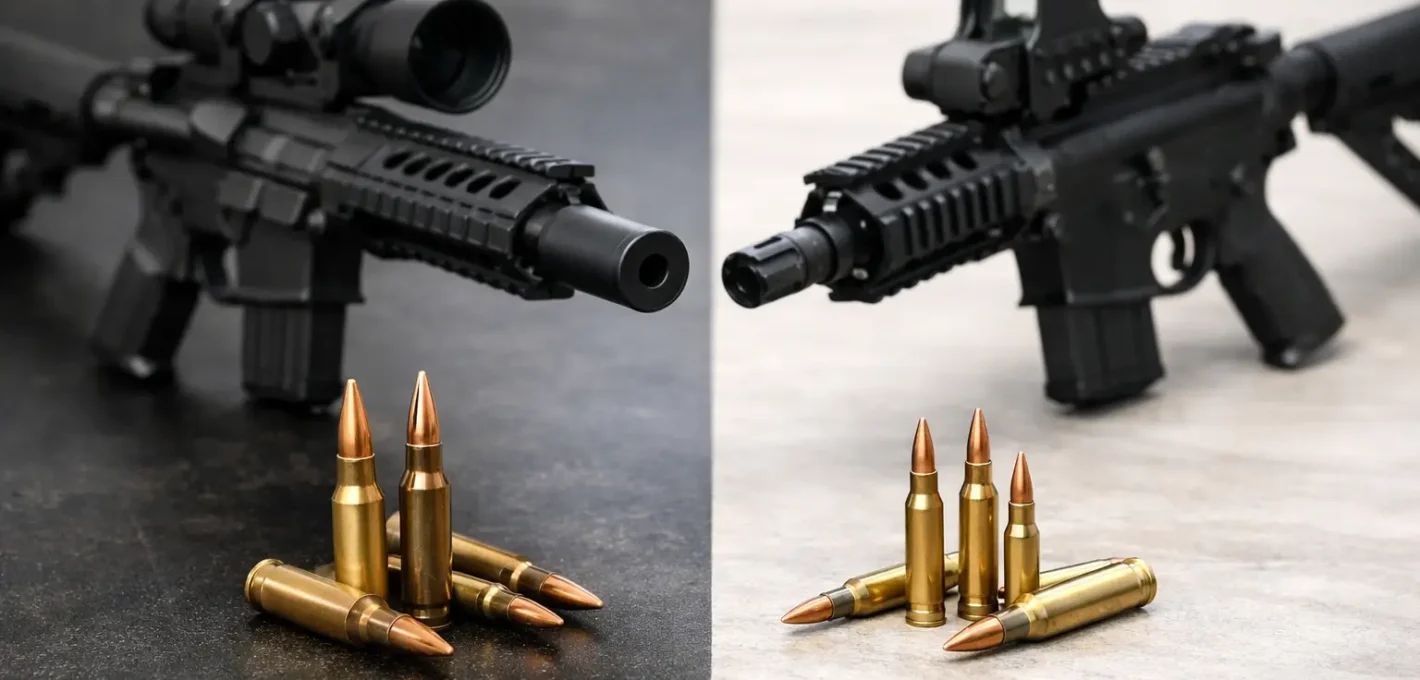

A short barrel, a suppressor, and a plan to hunt hogs at close range can make one cartridge look like the clear winner. Stretch that same rifle setup into a longer-range coyote stand or a high-volume range day, and the answer changes fast. That is why the 300 blackout vs 556 debate never really goes away – both rounds perform well, but they solve different problems.
For practical shooters, hunters, and AR owners, this comparison is less about hype and more about fit. You want a cartridge that matches how you actually shoot, where you actually hunt, and what kind of rifle setup you plan to run. When you look at barrel length, recoil, effective distance, ammo cost, and terminal performance, the differences become much easier to sort out.
300 blackout vs 556 at a glance
If you want the fast read, 5.56 NATO is usually the stronger all-around pick for affordability, flatter trajectory, and longer effective range. It shines for target shooting, training, predator work, and general-purpose use in standard AR platforms.
.300 Blackout earns its reputation in short-barreled rifles, suppressed setups, and close-range hunting. It was built to deliver reliable performance from compact platforms, and it does that extremely well. The trade-off is that it generally costs more per round and drops faster at distance.
That means neither option is automatically better. The better cartridge is the one that fits your mission.
What makes .300 Blackout different?
.300 Blackout was designed to give AR-platform shooters a .30-caliber option that works with standard AR magazines and bolts while delivering strong performance from short barrels. That matters because many cartridges lose a lot when barrel length gets trimmed down. .300 Blackout handles that reality much better than 5.56.
It also offers a wider split between supersonic and subsonic use. Supersonic .300 Blackout loads are commonly used for deer-sized game and defensive applications at short to moderate distances. Subsonic loads are especially attractive for suppressed shooting, where reduced noise is a major advantage.
That flexibility is the cartridge’s biggest selling point. If your setup revolves around a compact rifle or pistol build, especially with a suppressor in the plan, .300 Blackout starts looking very compelling.
Where 5.56 still dominates
5.56 remains the benchmark because it is efficient, proven, and easy to live with. Ammo is usually more available, less expensive, and better suited for high-volume shooting. For many buyers, that alone keeps 5.56 in the top spot.
It also offers a flatter trajectory than .300 Blackout, which makes hits at extended distances more forgiving. If your shooting involves 200, 300, or 400 yards with regularity, 5.56 gives you less holdover and a little more breathing room. That matters on the range and in the field.
There is also the recoil factor. While neither cartridge is hard-kicking, 5.56 tends to feel lighter and faster, especially in standard carbines. That can translate into quicker follow-up shots and less fatigue during long range sessions.
Barrel length changes the whole conversation
This is where a lot of shoppers make the wrong call. They compare the cartridges in theory instead of comparing them in the rifle they actually want to build or buy.
If you are running a 16-inch rifle and using it as a general-purpose setup, 5.56 is hard to beat. It delivers excellent velocity, useful range, and strong overall value. In that format, it feels like the practical choice because it is.
If you move to a short-barreled platform, .300 Blackout becomes much more attractive. It was built with short barrels in mind, and it gives up far less performance in compact configurations. In a 9-inch or 10.5-inch setup, .300 Blackout often feels like it is operating exactly where it was meant to.
5.56 can absolutely run in shorter barrels, but the performance trade-offs become more noticeable. Blast, flash, and velocity loss all start to stack up. That does not make it a bad option. It just means the cartridge has a different sweet spot.
Hunting performance: deer, hogs, and predators
For hunting, distance and game size matter more than internet arguments. .300 Blackout is a legitimate option for deer and hogs inside reasonable ranges when paired with the right bullet. It delivers heavier projectiles and solid terminal performance in closer shots, which makes it appealing for thick cover, feeder setups, and woods hunting.
That said, it is not a long-range hammer. Once distance increases, drop becomes more pronounced and energy falls off faster. Ethical shot placement becomes less forgiving. For hunters who expect shots to stay relatively close, that is manageable. For hunters facing open-country distances, it becomes a limitation.
5.56 is often chosen for varmints and predators because it is fast, flat, and easy to shoot well. For deer hunting, legality varies by state and bullet selection matters a great deal. Some hunters use it successfully within its limits, but it is generally less forgiving on larger game than a well-loaded .300 Blackout. If your primary goal is coyotes and range work, 5.56 makes a lot of sense. If your focus is hogs in tighter terrain, .300 Blackout can have the edge.
Suppressed shooting and subsonic use
This is the section where .300 Blackout separates itself most clearly. If suppressed performance is central to your setup, especially with subsonic ammo, .300 Blackout was built for that role. It offers a shooting experience that many owners specifically buy the cartridge to get.
Subsonic .300 Blackout is not about speed. It is about quiet operation, controllability, and effectiveness at closer distances. For certain hunting and defensive roles, that can be a major advantage.
5.56 can be suppressed, and many shooters do exactly that. But if your goal is a true suppressor-first build, 5.56 does not deliver the same subsonic-friendly profile. It can still be effective, but it is not the cartridge’s standout lane.
Ammo cost and availability
For many buyers, this is where the decision gets real. 5.56 is usually easier to find and easier on the wallet. That matters if you train often, shoot in volume, or simply want to stock up without cringing at checkout.
.300 Blackout tends to cost more, and that difference adds up quickly. A shooter who practices regularly may fire enough rounds in a year to make ammo cost the deciding factor. It is hard to ignore when one cartridge lets you shoot more for the same budget.
This does not mean .300 Blackout is poor value. If it fits your rifle and your use case better, the premium can be justified. But if you are mainly buying for range days, repetition, and general utility, 5.56 usually wins the value argument.
Home defense and practical use
Both cartridges can serve in defensive roles, but setup matters. In a compact AR with the right load, .300 Blackout offers strong short-range performance and excellent compatibility with short barrels. That makes it appealing for shooters who want a maneuverable platform without giving up effectiveness.
5.56 remains a common defensive choice because it is controllable, widely supported, and effective with quality ammunition. It also tends to be the easier cartridge to practice with extensively due to lower ammo cost.
The real answer comes down to how you intend to configure the rifle. If you want a short suppressed platform, .300 Blackout has a strong case. If you want a more traditional carbine that can handle defense, training, and general shooting equally well, 5.56 is still a premier choice.
So which one should you buy?
If you want one AR cartridge for range use, training, broad ammo availability, and better performance at distance, 5.56 is the cleaner choice. It is efficient, versatile, and still the standard for a reason.
If you want a cartridge built around compact rifles, close-range hunting, and suppressed use, .300 Blackout stands out. It fills a specific role better than 5.56, and when your setup matches that role, it can feel like the smarter and more capable option.
Serious shooters know gear decisions get better when they are tied to real use, not trend chasing. If your priority is affordable repetition and all-around utility, lean 5.56. If your priority is short-barrel performance and hard-hitting close-range capability, lean .300 Blackout. Prime Outdoor Shop serves buyers who want that kind of confident fit, because the right ammo choice should feel like an upgrade the moment you hit the range or step into the field.
The smartest move is to buy for the rifle you will actually carry, the distance you will actually shoot, and the game or role you actually have in front of you.